En daar zijn van dezelfde maker meer 'amazing' video's te zien.
dinsdag 23 oktober 2012


maandag 22 oktober 2012
Architecten over het opleiden van architecten [1]: Louis I. Kahn
Van oudsher zijn architecten nauw betrokken geweest bij het opleiden van de volgende generaties architecten. Met de opleidingen Architectuur en Interieurarchitectuur van ArtEZ Academie van Bouwkunst willen we uitspraken verzamelen van architecten en interieurarchitecten over het opleiden van nieuwe vakgenoten. Behalve dat we zelf op zoek zullen gaan naar uitspraken en citaten willen we de lezers van deze weblog ook vragen om suggesties of uitspraken (met bronvermelding) aan ons door te geven. Dat kan per emial via: academievanbouwkunst@artez.nl.
Om te beginnen volgt hier een citaat van Louis I. Kahn - actueel door de grote overzichtstentoonstelling die tot 6 januari 2013 in het NAi te zien is.
Louis Kahn sprak in het voorjaar van 1968 met studenten van Rice University School of Architecture (Houston) over verschillende thema's in de architectuur. Een neerslag van die gesprekken verscheen een jaar later onder de titel "Louis I. Kahn - Conversations with Students", uitgegeven door Rice University en Princeton Architectural Press (1e editie 1969, 2e editie 1998). Op de pagina's 30 - 33 vertelt Louis Kahn over 'teaching architecture'.
"We were talking earlier this afternoon
Of the three aspects of teaching architecture.
Actually, I believe that I do not really teach architecture,
But that I teach myself.
These, however, are the three aspects:
The first aspect is professional.
As a professional you have the obligation of
learning your conduct in all relationships . . .
in institutional relationships,
and in your relationship with men who
entrust you with work.
In this regard, you must know the distinction
between science and technology.
The rules of aesthetics also constitute professional knowledge.
As a professional, you are obliged to translate
the program of a client into that of the spaces of
the institution this building is to serve.
You might say it is a space-order,
or a space-realm of this activity of man
which is your professional responsibility.
A man should not take the program
and simply give it to the client
as though he were filling a doctor's prescription.
Another aspect is training a man to express himself.
This is his own prerogative.
He must be given the meaning of philosophy,
the meaning of believe, the meaning of faith.
He must know the other arts.
I used examples which I maybe have used too many times,
but the architect must realize his prerogative.
He must know that a painter can turn people upside down,
if he wants to, because the painter does not have to
answer to the laws of gravity.
The painter can make doorways smaller than people;
he can make skies black in the daytime;
he can make birds that can't fly;
He can make dogs that can't run, because he is a painter.
He can paint red where he sees blue.
The sculptor can place square wheels on a cannon
to express the futility of war.
An architect must use round wheels,
and he must make his doorways bigger than people.
But architects must learn that they have other rights . . .
their own rights.
To learn this, to understand this,
is giving the man the tools for making the incredible,
that which nature cannot make.
The tools make psychological validity,
not just physical validity,
because man, unlike nature, has choice.
The third aspect you must learn
is that architecture really does not exist.
Only a work of architecture exists.
Architecture does exist in the mind.
A man who does a work of architecture
does it as an offering to the spirit of architecture . . .
a spirit which knows no style,
knows no techniques, no method.
It just waits for that which presents itself.
There is architecture, and it is the embodiment
of the unmeasurable.
Can you measure the Parthenon?
No. This is sheer murder.
Can you measure the Parthenon,
that wonderful building which satisfies the institution of man?
When Hadrian thought of the Pantheon,
he wanted a place where anyone could come to worship.
How marvelous is this solution.
It is a non-directional building,
not even a square, which would give, somehow,
directions and points and corners.
There was no chance to say that
there is a shrine here, or there. No.
The light from above is such that you can't get near it.
You just can't stand under it;
it almost cuts you like a knife. . .
and you want to stay away from it.
What a terrific architectural solution.
This should be an inspiration for all architects,
such a building
so conceived."
Om te beginnen volgt hier een citaat van Louis I. Kahn - actueel door de grote overzichtstentoonstelling die tot 6 januari 2013 in het NAi te zien is.
Louis Kahn sprak in het voorjaar van 1968 met studenten van Rice University School of Architecture (Houston) over verschillende thema's in de architectuur. Een neerslag van die gesprekken verscheen een jaar later onder de titel "Louis I. Kahn - Conversations with Students", uitgegeven door Rice University en Princeton Architectural Press (1e editie 1969, 2e editie 1998). Op de pagina's 30 - 33 vertelt Louis Kahn over 'teaching architecture'.
"We were talking earlier this afternoon
Of the three aspects of teaching architecture.
Actually, I believe that I do not really teach architecture,
But that I teach myself.
These, however, are the three aspects:
The first aspect is professional.
As a professional you have the obligation of
learning your conduct in all relationships . . .
in institutional relationships,
and in your relationship with men who
entrust you with work.
In this regard, you must know the distinction
between science and technology.
The rules of aesthetics also constitute professional knowledge.
As a professional, you are obliged to translate
the program of a client into that of the spaces of
the institution this building is to serve.
You might say it is a space-order,
or a space-realm of this activity of man
which is your professional responsibility.
A man should not take the program
and simply give it to the client
as though he were filling a doctor's prescription.
Another aspect is training a man to express himself.
This is his own prerogative.
He must be given the meaning of philosophy,
the meaning of believe, the meaning of faith.
He must know the other arts.
I used examples which I maybe have used too many times,
but the architect must realize his prerogative.
He must know that a painter can turn people upside down,
if he wants to, because the painter does not have to
answer to the laws of gravity.
The painter can make doorways smaller than people;
he can make skies black in the daytime;
he can make birds that can't fly;
He can make dogs that can't run, because he is a painter.
He can paint red where he sees blue.
The sculptor can place square wheels on a cannon
to express the futility of war.
An architect must use round wheels,
and he must make his doorways bigger than people.
But architects must learn that they have other rights . . .
their own rights.
To learn this, to understand this,
is giving the man the tools for making the incredible,
that which nature cannot make.
The tools make psychological validity,
not just physical validity,
because man, unlike nature, has choice.
The third aspect you must learn
is that architecture really does not exist.
Only a work of architecture exists.
Architecture does exist in the mind.
A man who does a work of architecture
does it as an offering to the spirit of architecture . . .
a spirit which knows no style,
knows no techniques, no method.
It just waits for that which presents itself.
There is architecture, and it is the embodiment
of the unmeasurable.
Can you measure the Parthenon?
No. This is sheer murder.
Can you measure the Parthenon,
that wonderful building which satisfies the institution of man?
When Hadrian thought of the Pantheon,
he wanted a place where anyone could come to worship.
How marvelous is this solution.
It is a non-directional building,
not even a square, which would give, somehow,
directions and points and corners.
There was no chance to say that
there is a shrine here, or there. No.
The light from above is such that you can't get near it.
You just can't stand under it;
it almost cuts you like a knife. . .
and you want to stay away from it.
What a terrific architectural solution.
This should be an inspiration for all architects,
such a building
so conceived."
 |
| Louis Kahn in gesprek met studenten. Afbeelding: p. 34 uit "Louis I. Kahn, Conversations with Students", Houston (Architecture at Rice Publications / Princeton Architectural Press), 1969 (1998). |
donderdag 13 september 2012
start case-study 2.0 | master interieurarchitectuur
Op 12
september is de case-study 2.0 van de master interieurarchitectuur van start
gegaan met een excursie naar Groningen. Opdrachtgever van deze case-study is
Hanbneke van Brakel van De Scholenbouwmeester. De stichting
Scholenbouwmeester Noord Nederland is een onafhankelijk expertisecentrum voor
de onderwijshuisvesting, met als kerngebied de provincies Groningen, Drenthe en
Fryslân. Kerntaak van de Scholenbouwmeester is Scholen en Krimp. Maar het
interdisciplinaire team houdt zich ook bezig met de kwaliteit van de nieuw te
bouwen scholen die de komende jaren zullen worden ontwikkeld. Het binnenklimaat
is daarbij een belangrijk aandachtspunt, maar ook de gezondheid , vermindering
energieverbruik en de bruikbaarheid van het interieur. Studenten zullen zich
binnen deze case-study met name met dat laatste onderwerp gaan bezig houden.


Na een
inleidend verhaal van Hanneke van Brakel in Paterswolde waar de
Scholenbouwmeester is gevestigd in een voormalige school, bezochten we onder
leiding van Hans de Man enkele scholen in Groningen uit verschillende
bouwperiodes van architecten als Wilhelm, Bouman, Onix en Drost en van Veen.
Hans de Man is interieurarchitect en architectuurhistoricus. Hij is betrokken
bij de Scholenbouwmeester en geeft les aan de opleidingen interieurarchitectuur
in Zwolle.
Scholenbouw
is een zeer actueel onderwerp.
Enerzijds heeft dat te maken met de Krimp in het Noorderland, anderzijds
met de staat van het huidige
scholenbestand. Een derde van het bestand bestaat uit gebouwen uit de
periode voor 1960, een derde uit de
70-er en 80-er jaren, een derde is van na 1990. Met name de scholen uit
de jaren 70 en 80 presteren slecht wat betreft het binnenklimaat en
energieprestatie. Daarnaast zullen als gevolg van de voortschrijdende krimp op
het platteland scholen samen op gaan in een nieuwe school. Op de website van
Scholenbouwmeester is veel informatie te vinden over dit onderwerp in de vorm
van artikelen en publicaties. Ook de documentaire ‘Verhalen van de scholen van het Noorderland’ is de moeite waard om te bekijken.
Ingrid van
Zanten
opening studiejaar | master interieurarchitectuur

Na een kennismakingsontbijt in Zwolle met de nieuwe eerste jaars studenten, bezochten de studenten van de master interieurarchitectuur bij de start van het nieuwe studiejaar Amsterdam-Noord.

Het
NDSM terrein, ‘selfmade city’, is
een plek waar ruimte is voor kunstenaarsinitiatieven, festivals,
vlooienmarkten, exposities en de HISWA te water. Veel kunstenaars,
theatermakers en ontwerpers hebben een werkplek of atelier gebouwd in de
voormalige scheepsbouwloodsen. Zo ook Rob ten Napel, interieurarchitect/
architect die in 2004 afstudeerde aan de bachelor interieurarchitectuur van
ArtEZ. Hij heeft ons rondgeleid en een paar bijzondere initiatieven laten zien,
zoals de Gewoonboot, Treehouse, Pllek en Noorderlicht.

Na de lunch in de Ykantine bezochten we het Kraanspoor waar Rob aan heeft gewerkt tijdens de periode dat hij werkte bij OTH. Dankzij een medewerkster van IDTV hebben we ook het prachtige uitzicht over het IJ kunnen bewonderen.

Op Overhoeks bezochten we de nieuwe woonblokken van Alvaro Siza en Tony Fretton.
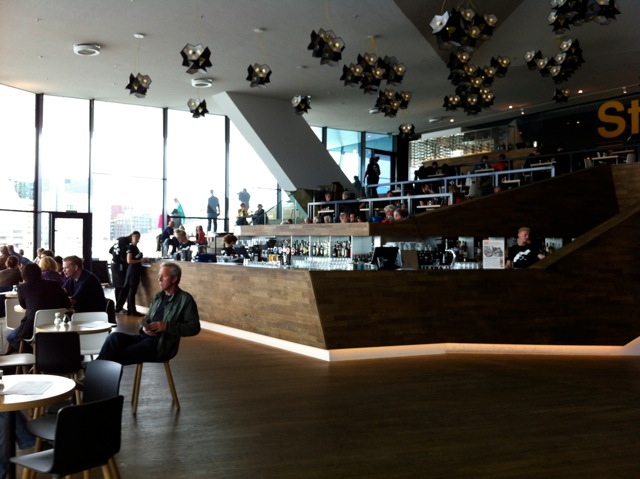
Later
in de middag volgde nog een rondleiding in EYE door De Gebouwengids.
vrijdag 7 september 2012
Rem Koolhaas: "Countrypride"
 |
| "Cartesian landscape" |
"Countrypride" zou de titel worden van zijn volgende publicatie, zei Rem Koolhaas met de nodige ironie en zelfspot op 25 april 2012 in de Lutherse Kerk te Amsterdam. Koolhaas verraste die avond vriend en vijand door zijn lezing volledig te wijden aan 'the countryside', het platteland, terwijl het thema van de avond toch echt "Facing Forward: Future City" heette. Pas aan het einde van zijn verhaal kwam hij weer bij de stad terecht.
maandag 3 september 2012
Opening studiejaar in Venlo | masteropleiding architectuur
 |
| Floriade Plaza, de centrale ruimte van het terrein met op de achtergrond de kabelbaan. |
 |
| Bij de ingang, aan de voet van de Innovatoren (ontwerp: Jo Coenen), krijgen we een toelichting op de uitleg en inrichting van het Floriade-terrein (masterplan: Jo Coenen; uitvoering: Arcadis) en op de bestemming van het terrein na afloop van de Floriade. |
 |
| The Dome, het gezamenlijke paviljoen van de Nederlandse Tuinbouw op het centrale groene plein. |
 |
| Het Nederlandse paviljoen "My Green World" van ontwerpbureau 2D3D, waarin veel nieuwe technologieën worden gepresenteerd. |
 |
| De binnenruimte van het Nederlandse paviljoen. |
 |
| Nieuwe technologie: het kweken van algen. "De alg: de reus van de toekomst." |
 |
| Op het terrein van de Floriade zijn diverse bijzondere archeologische en historische plekken. Een grafheuvel uit de bronstijd wordt hier in de kijker gezet. |
 |
| De Nedinsco fabriek in Venlo, een fraai industrieel rijksmonument uit de jaren 20. Het wordt volledig gerenoveerd door DiederenDirrix architecten. Het gebouw zal naast appartementen ook ruimte gaan bieden aan de regionale tv-zender. |
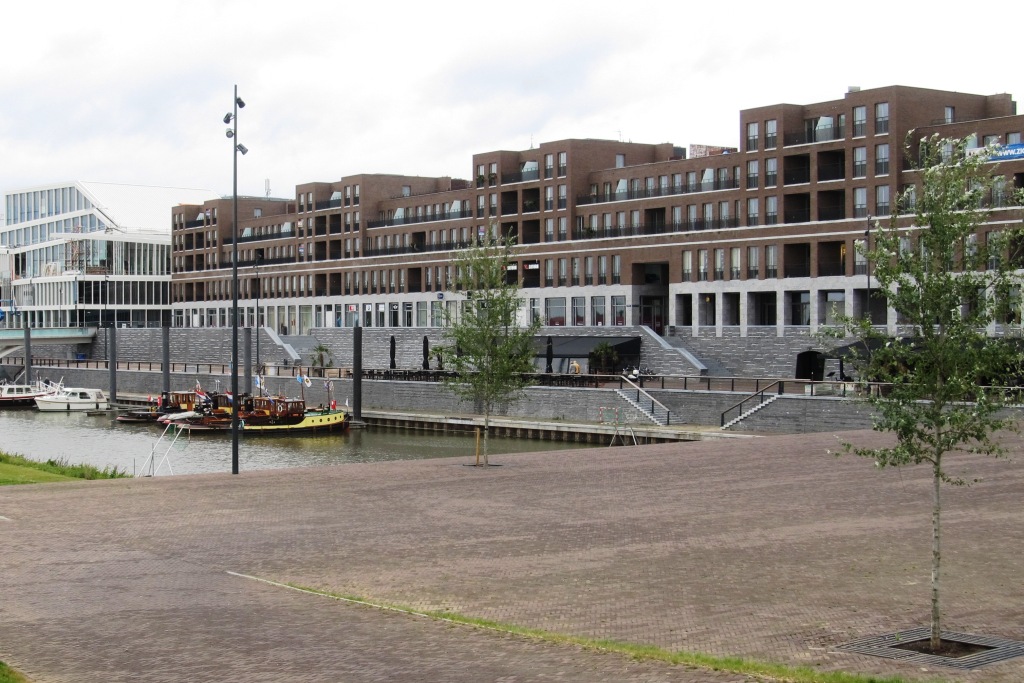 |
| De nieuwe Maasboulevard aan de haven. |
 |
| Aansluiting van de nieuwe Maasboulevard op de bestaande binnenstad. |
 |
| Venlo heeft veel en ambitieuze plannen. Hier geeft het hoofd Stedenbouw van Venlo uitleg over de ingrepen in de wijk Q4. Een overzicht van de plannen in Venlo is te vinden op: www.venlovernieuwt.nl. |
dinsdag 28 augustus 2012
Dead Architects Society: Louis I. Kahn
 |
| Louis Kahn, Philips Exeter Academy Library, 1971 (afbeelding van wikimedia commons) |
Er zijn architecten van wie het werk zo prikkelend, krachtig of onalledaags is dat het anderen blijft inspireren. Zo ook bij Louis I. Kahn (1901-1974). Nadat in 2003 zijn zoon Nathaniel Kahn de prachtige en ontroerende documentaire "My Architect: A Son's Journey" had gemaakt, is er nu ook een opera over zijn werk: "Architect. A Chamber Opera".
En als klap op de vuurpijl is er in het NAi een grote tentoonstelling over zijn werk van 8 september tot 6 januari 2013: "Louis Kahn: The Power of Architecture".
Abonneren op:
Posts (Atom)